
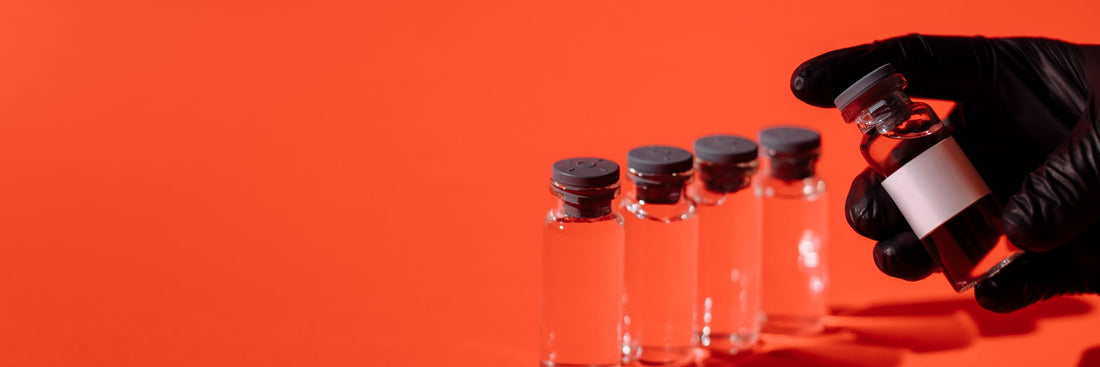

In 1989, a Croatian researcher called Predrag Sikirić had, after more than a decade of trying, finally isolated a molecule he called BPC-157 — one that, in his experiments, seemed to heal and protect almost every tissue in the body.
Fast-forward to today, and BPC-157 is embroiled in controversy. There are plenty of examples of people saying that it works — including a widely shared Joe Rogan clip in which a guest describes elbow tendonitis that "just could not fix," gone in two weeks after starting BPC-157 [1].
And this month it landed in front of the FDA, where an advisory panel voted to make it easier to get — overruling the agency's own scientists, who said the evidence simply isn't there [2].
But if it doesn't work… why did the World Anti-Doping Agency ban it? The answer is strange. And it starts with the question Sikirić couldn't let go of.
Your stomach holds acid strong enough to strip the meat off a bone. Yet it doesn't digest itself. Something is protecting it. But what?
Table of Contents
- The Obsession
- The Compound That Healed Everything
- The Pharma Years
- The Orphan, and the Leap
- The Ban
- References
The Obsession
In 1975, Sikirić is a second-year medical student at the University of Zagreb, in Croatia — then one of the republics of Yugoslavia. And he becomes fixated on that stomach puzzle. He reaches a conclusion nobody is teaching him: the stomach must make its own protective, healing substance. Some natural compound that keeps it from eating itself alive.
He half-jokingly gives the thing he's hunting a name. "Substance God help me."

Finding it took Sikirić more than a decade. Collecting gastric juice. Chasing a substance no one was even sure existed. One stubborn idea, against years of nothing. But in 1989, after more than a decade… Sikirić finally had it.
The Compound That Healed Everything
His team's first paper on it lands in 1992. And it turns out to be a fragment — a small piece snipped off a much larger protein [3]. BPC-157 is just the first fifteen building blocks of that bigger protein. Fifteen amino acids in a row. A peptide. BPC, by the way, stands for Body Protection Compound.

And then comes the part that makes this story so strange. They took that tiny fragment, and they started testing it on everything.
In rats, they triggered stomach ulcers three different ways — with stress, with a chemical called cysteamine, and with almost pure alcohol. Three separate ways of wrecking a stomach. And BPC-157 protected against all three. The researchers reported that "only BPC 157 regimes were consistently effective in all of the tested models" [4].
Then, tendons. Tendons are notoriously slow to heal, because they barely have a blood supply. So it was a big deal when they cut a rat's Achilles tendon clean through, gave it BPC-157, and the tendon didn't just improve — the researchers described a full recovery, "the reestablishment of full tendon integrity." That was in a rat [5].

Then skin wounds. Then muscle. Then bone. Even nerve. And they started working out how it might be doing all this.
First, it seemed to calm inflammation. In one rat study, they irritated the animal's nose with capsaicin — the compound that makes chilli peppers hot — and BPC-157 blunted the reaction. The more they gave, the bigger the effect: a "dose-dependent protective effect" [6].

Second, it grew new blood vessels. It switched on a growth signal called VEGF, and new vessels formed. More blood supply, faster healing. It also seemed to act through nitric oxide, which controls blood flow [7][8].
Overall, for every injury they could think of, BPC-157 seemed to protect and heal almost all of it. Sikirić's group were so struck by it that they proposed it might be the first of an entirely new class of medicines — "a useful prototype of a new class of drugs," which they called organoprotective agents [9].
And a compound that heals everything is one of two things. A genuine breakthrough. Or a warning sign.
There's one more early finding worth holding onto, because it comes back later — and it's an odd one. Sikirić's own lab in 1997 also reported that BPC-157 did something in the brain: it blunted the effects of amphetamine, blocking "the stereotypy produced acutely by amphetamine" [10].
For a while, all of this research made it look like BPC-157 might actually become a real medicine. Because a real drug company thought so too.
The Pharma Years
In 1993, a Croatian pharmaceutical company called PLIVA licensed it, and they ran a human clinical trial.
Remember, the original BPC-157 research was looking at the gut. So PLIVA ran a human, randomized, placebo-controlled trial for the bowel disease ulcerative colitis. They gave BPC-157 as an enema [11].

That trial finished twenty years ago. And it was never published in full. For two decades, nobody outside that company could see how it had turned out.
Until this month. Because when the FDA finally sat down to review BPC-157, they put the numbers into a public document. Fifty-three patients. BPC-157 as an enema, against placebo, for two weeks. And the difference between the two groups came out at 1.6 points on a disease-activity score — with a confidence interval that crossed zero [12].

Which is the statistical way of saying: this could just as easily have been nothing at all. The FDA's own summary put it plainly — the data were "inadequate to support the efficacy and safety of BPC-157 given as an enema for two weeks" [12].
Then in 2006, the pharmaceutical giant GSK bought PLIVA's research arm. The BPC-157 programme was quietly dropped. The rights to BPC-157 drifted back to Sikirić. And the compound fell out of the pharmaceutical world entirely, never to return — and here's why.
The Orphan, and the Leap
Patents last twenty years. The patent covering the molecule was filed in 1990. Which means in 2011, it expired. Once something is out in the open, that door is closed forever. Nobody can own it.
Which means the general public can get their hands on it from grey-market labs — but it also means that no company can ever make its money back running the big, expensive human trial. Because the moment they proved it worked, every grey-market lab on earth would sell the exact same molecule, at a fraction of the price, having spent nothing. So the trials just… stopped. Not because of a conspiracy. Because of arithmetic. As one 2026 review put it, the original composition-of-matter patents "have likely expired… reducing the commercial exclusivity that typically incentivizes industry-sponsored Phase II and III development" [13].

To date, there's only one published human study of BPC-157. It's a look-back, survey study of sixteen people who'd had BPC-157 injected into a painful knee. No control group. No placebo. Just asked, months later, whether they felt better [14]. And knees get better on their own all the time. It tells us almost nothing.
The only other human study was in 2015. But by 2016, the researchers cancelled the submission of the results [15].
So that's the science. It's stalled out. But out in the real world, something completely different was happening. Bodybuilders and biohackers dug up those old rat tendon studies. And they started injecting BPC-157 into their own shoulders and knees. A drug built for the gut had become a tendon injection.

And here's what the FDA said about that, this month. They went looking for human studies of BPC-157 given by injection, or by mouth, or as a nasal spray, or through the skin — every route people actually use. They found "no studies that administered BPC-157 to humans via the proposed oral, SC, nasal, or transdermal ROA" [12]. (SC means subcutaneous — injected.)
Now, to be fair to the idea — remember, from the animal work, that BPC-157 grows new blood vessels. In theory, more blood supply, faster healing. Which might be great news for tendons, which don't have a great blood supply.
But growing new blood vessels is also exactly what a tumour needs in order to grow. So the honest position is this. Nobody has shown that BPC-157 causes cancer. Nobody has shown that it doesn't. Nobody has run the experiment. Sikirić says the risk is, in his words, "entirely excluded," based on a cell study from 2004. That statement has drawn a lot of criticism because, as other researchers rightly point out, we lack the human safety data — and "to date, no published in vivo data demonstrate that BPC 157 inhibits tumor progression, reduces tumor volume, or suppresses metastasis" [16].
Then there's that 1997 finding — the one where BPC-157 blunted amphetamine, from Sikirić's own lab. People online are now reporting that BPC-157 flattens their mood and dulls their stimulant medication. That comes from a data-mining project on Reddit, so take it with a big pinch of salt. It's aggregated anecdote, not evidence. But it's anecdote pointing straight at something his own lab published nearly thirty years ago.
And here's the deepest blank of all — and it takes us right back to Sikirić himself. Remember that larger protein, the one BPC-157 is supposedly just a piece of? In more than thirty years, he has never published its full sequence.
And when independent researchers went hunting for the gene that would build it — in the human genome, in our gut bacteria — they couldn't find it. Anna Mapp, a chemist at the University of Michigan and president of the American Peptide Society, reviewed his work and put it bluntly: "There was no demonstration that I could tell that it was a single pure isolated substance" [17][18][19]. So why won't he release it? His answer, when a reporter asked, tells you a lot about the man at the centre of all this: "If you have your own child, you want it to be yours forever."

And then there are the more ordinary knowledge blanks — and they are still big ones. Not only do we not have the full sequence of the original stomach molecule that gave rise to BPC-157, nobody has ever found the receptor BPC-157 is supposed to actually work through. It clears out of your blood in under thirty minutes — yet people claim effects that last for days. And there is no pharmaceutical-grade version of it anywhere in the world. Nothing made to a real medical standard.
Which brings us to this month. Because BPC-157 went in front of an FDA advisory panel. And you may have seen the headlines saying the FDA approved it. It didn't.
What actually happened is narrower, and stranger. A panel of outside advisers voted, by a single vote, to recommend that pharmacies be allowed to compound it. That recommendation is non-binding. The FDA hasn't agreed to it. No rule has been written. Nothing has changed, and any actual rule is likely a year or more away.

And here's the part that matters most. The FDA's own scientists had already reviewed all of this data, and recommended against it because of a lack of evidence: "Accordingly, we propose not adding BPC-157 (free base) or BPC-157 acetate to the 503A Bulks List" [12].
And listen to the problem one FDA official laid out at that meeting. BPC-157 isn't a recognised pharmaceutical ingredient in the United States. There's no legal definition of what it actually is. Which means two vials with the very same name on the label can contain different things. So the agency can't even write a quality standard for it — because it can't say what "it" is. In the words of Russell Wesdyk, associate director in FDA's drug center: "There's no way to know what the substance actually is, was or will be tomorrow because that name has no legal meaning" [20].
The panel voted anyway. And the only condition they were even considering it for was ulcerative colitis. The gut. Not tendons. Not injuries. Not the reason almost anyone is actually buying it. The regulators are still looking exactly where Sikirić pointed fifty years ago. Everyone else is injecting a shoulder or an elbow. Which takes us all the way back to where we started. And that ban.
The Ban
So. If there's almost no human evidence… why did the World Anti-Doping Agency ban it? Here's the answer. They didn't ban it because it works. They put it on a list called S0: "Non-Approved Substances." It is the category for things that no health authority, anywhere in the world, has approved for use in humans. As the anti-doping guidance states: "Because BPC-157 has not been extensively studied in humans, no one knows if there is a safe dose, or if there is any way to use this compound safely" [21].

So the ban was never proof that it works. It's the opposite. It's an official statement that nobody knows what it does — much like the FDA's official position. And that compounding list the panel just voted for? By law, that list exists specifically for substances that aren't approved. Getting onto it isn't an approval. It's the formal acknowledgement that you never got one.
And that's the whole story, start to finish. A stubborn idea from 1975. A young researcher who spent his life on it. A compound that healed everything — in rats. A real human trial whose result nobody saw for twenty years. A molecule no company can own, so no company will ever finish testing it. And a stack of the most basic questions — is it safe, at what dose, made by whom, and how exactly does it work — that still, today, do not have answers.
The honest bottom line is simply that the evidence isn't there yet. Not that it's been disproven. That it's never been properly tested in people at all. What you choose to do with that is up to you.
References
1. https://youtu.be/KN91N_VoowU
3. https://patents.google.com/patent/US5288708A
4. https://www.sciencedirect.com/science/article/abs/pii/0024320594007969
5. https://onlinelibrary.wiley.com/doi/10.1016/S0736-0266(03)00110-4
6. https://pubmed.ncbi.nlm.nih.gov/9065615/
7. https://pubmed.ncbi.nlm.nih.gov/20388964/
8. https://www.eurekaselect.com/article/52839
9. https://www.sciencedirect.com/science/article/abs/pii/092842579390038U
10. https://doi.org/10.1016/S0006-3223(97)00277-1
11. https://cir.nii.ac.jp/crid/1573105975523152000
12. https://www.fda.gov/media/193343/download
13. https://www.mdpi.com/1999-4923/18/5/625
14. https://pubmed.ncbi.nlm.nih.gov/34324435/
15. https://doi.org/10.3390/ph18020185
16. https://doi.org/10.3390/ph18101451
17. https://undark.org/2026/05/29/stress-test-bpc-157-history/
18. https://www.statnews.com/2026/06/01/bpc-157-researcher-predrag-sikiric-addesses-skeptics-questions/
19. https://americanpeptidesociety.org/news/the-bpc-157-question/
21. https://www.usada.org/spirit-of-sport/bpc-157-peptide-prohibited/


